

If you’re setting up your business online, you’ll hear two things:
Both sides are confident. But they’re usually selling you something.
Here’s what matters: a website and a funnel do completely different jobs. If you don’t understand the difference, you’ll either waste time building the wrong thing, or worse — spend money sending traffic to something that doesn’t convert.
A website gives visitors control. They can browse, compare, read, and decide on their own timeline. It works well when someone already knows who you are — maybe they found you on Google, got a referral, or saw your name somewhere and now they’re checking you out. They’re curious, but not ready to act. A good website gives them space to learn without pushing them too hard.
A funnel does the opposite. It takes control of the experience. It’s built to guide one person toward one outcome. You might be offering a free download, booking a call, or selling something directly — either way, the funnel removes all distractions and asks for a decision. Fast.
This is why the “website vs funnel” debate matters. If you’re running paid ads and sending cold traffic to a generic homepage, you’re burning cash. The person landing on your site doesn’t know what to click, where to start, or what matters. But if you’re trying to build long-term visibility and credibility through Google — and all you have is a three-step funnel — no one will ever find you.
You don’t need to pick one forever. Most businesses use both. The smart move is understanding what each one does best — and using them in the right context.
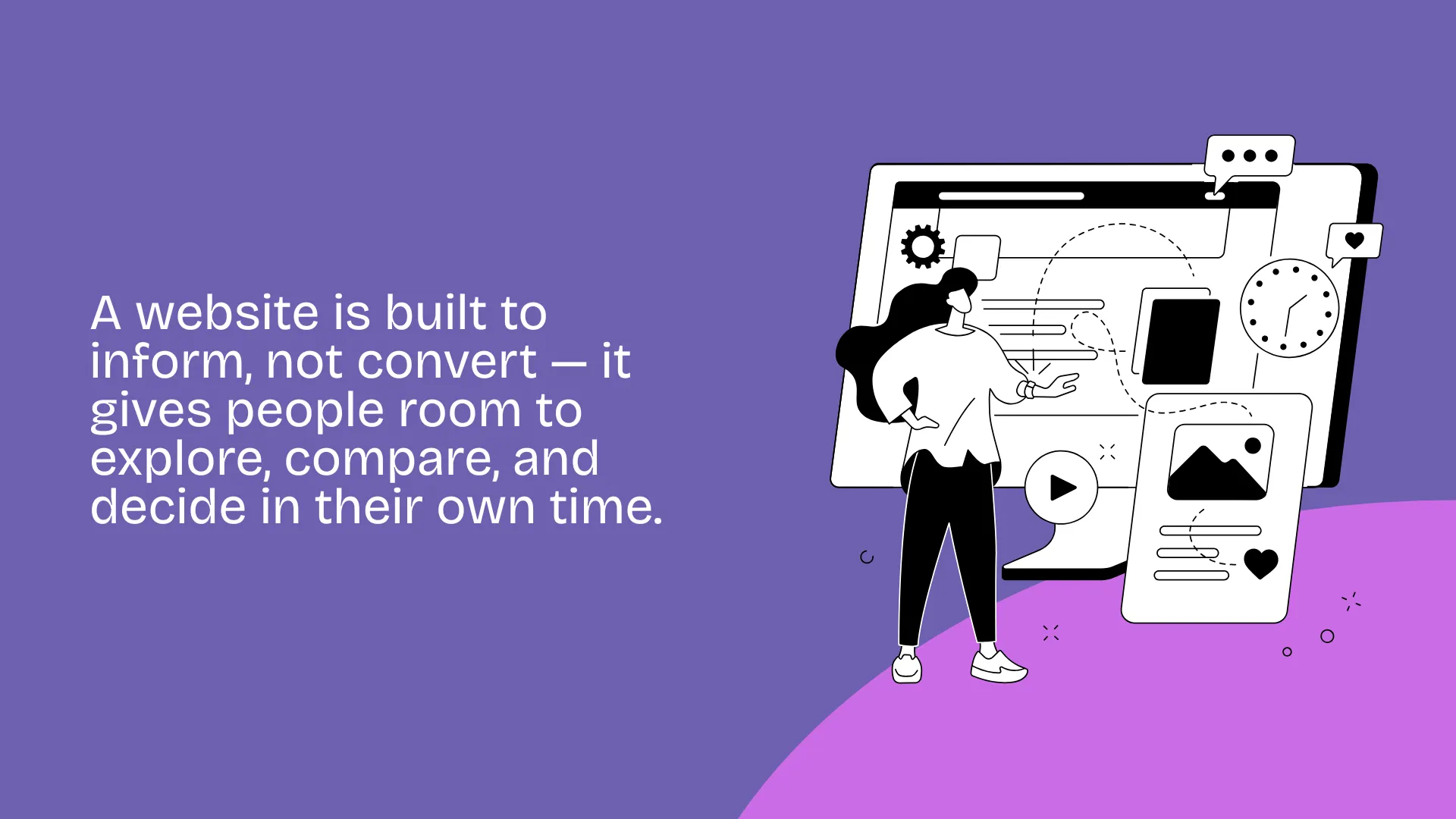
A website is your online base. It’s where people go when they want to learn more about you — not when they’re ready to take action straight away.
Here’s what a website actually does:
Most websites have:
Websites are great for credibility. They show you’re real. But they’re not built to drive instant action — which is why they often don’t convert well if you send cold ad traffic to them.
You need a website if:
Just don’t expect a website to do a funnel’s job.
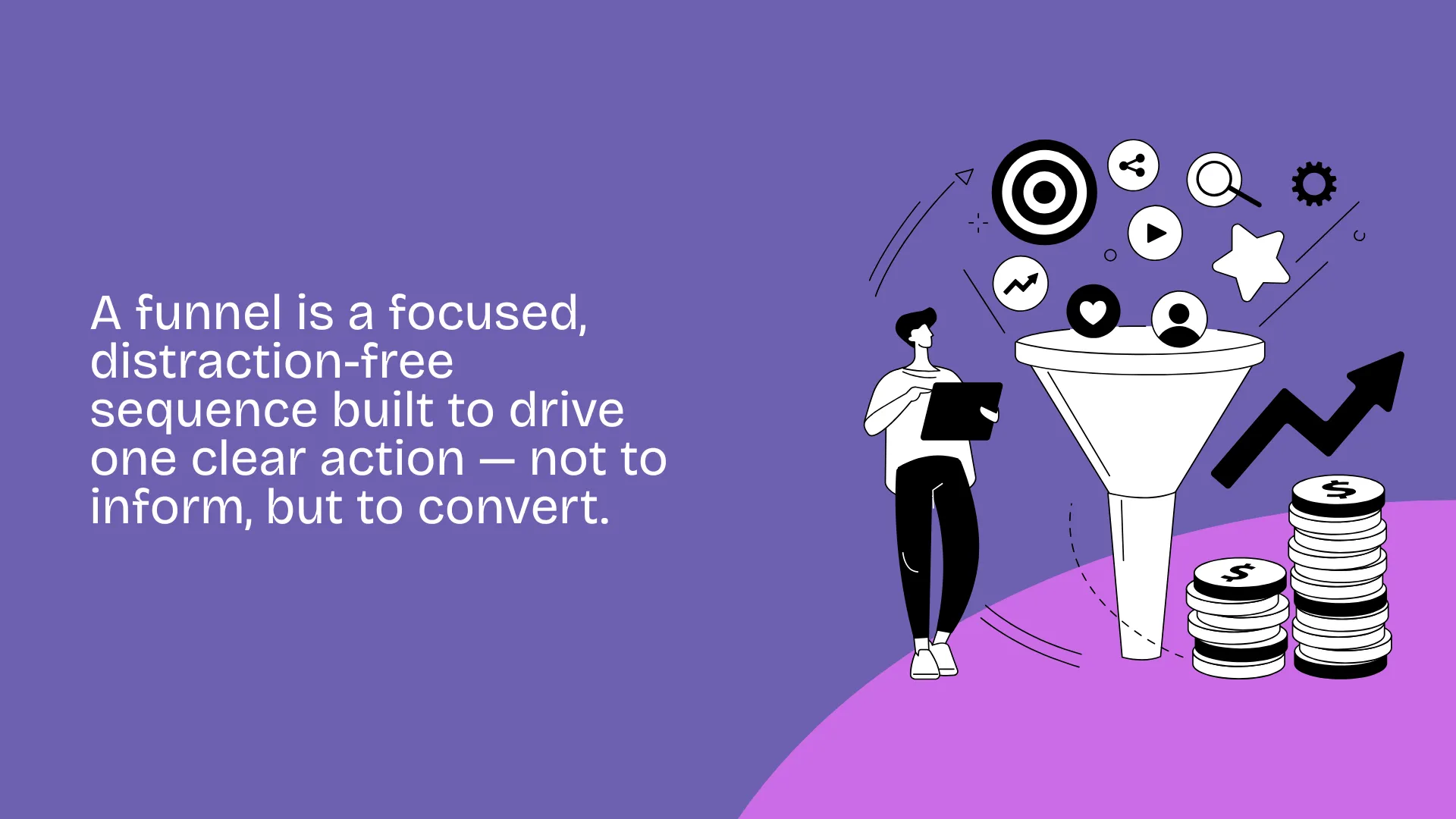
A funnel is built to do one thing — get someone to act.
Buy. Book. Sign up. That’s it.
There’s no homepage, no menu, no wandering around. Just a single path, step by step.
Here’s what a funnel actually does:
Most funnels follow a structure like this:
Funnels are ideal when:
Funnels convert better because they’re not built to explain — they’re built to close.
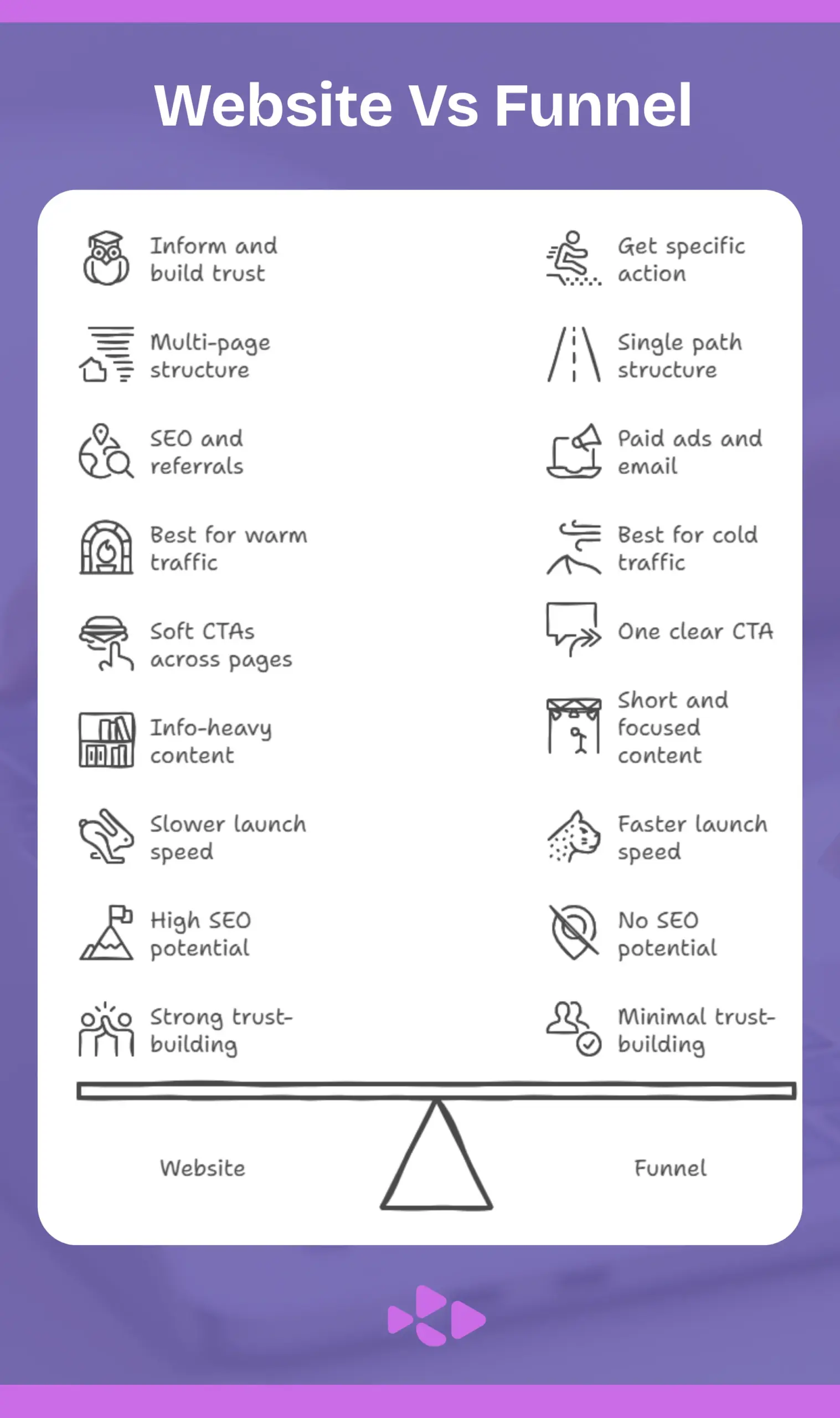
A lot of people get stuck trying to choose between a website and a funnel. Seeing the difference side by side makes it easier.
Here’s how they actually compare:
| Feature | Website | Funnel |
|---|---|---|
| Main goal | Inform, build trust, let people explore | Get a specific action (buy, book, sign up) |
| Structure | Multi-page, open navigation | Single path, one step after the other |
| Traffic source | SEO, referrals, direct search | Paid ads, email marketing, social campaigns |
| Best for | Warm traffic, research-driven visitors | Cold traffic, fast decisions |
| Conversion style | Soft CTAs across pages (“Learn more”, “Contact us”) | One clear CTA (“Buy now”, “Book a call”) |
| Content depth | Covers multiple services, info-heavy | Short, sharp, focused on one offer |
| Speed to launch | Slower — more pages, more content | Faster — fewer pages, faster testing |
| SEO potential | High — content can rank in search | None — funnels don’t rank on Google |
| Trust-building | Strong — shows credibility and depth | Minimal — relies on urgency and clarity |
| Use case example | A local business with multiple services | A Facebook ad offering a limited-time deal |
If you’re trying to build trust, go with a website.
If you’re trying to generate leads or sales quickly, use a funnel.
Most businesses eventually use both — they just don’t do the same job.
Use a website when people need time to decide. That’s the simplest way to put it.
Websites work best when someone’s doing research, comparing options, or just trying to get a feel for who you are. They’re not in a rush. They want to understand what you do, how it works, and whether they can trust you. A good website gives them the space to do that.
Here’s when a website makes sense:
Related: How much does a website cost in Australia?
Use a funnel when you want a result — now. Funnels are built for action, not browsing.
They don’t explain everything about your business. They don’t ask people to explore or learn more. They push one thing. One message, one offer, one button. And when you use them properly, they convert better than any website ever could.
Here’s when a funnel makes sense:
Yes — and you probably should.
Websites and funnels do different jobs. The smartest businesses don’t choose between them — they use both. Not at the same time, and not for the same audience. But side by side, each one supports the other.
Here’s how that looks in practice:
You’re not sending everyone to the same place. Here’s the split:
If you try to make one do the job of the other, things fall apart. A funnel that tries to act like a website becomes confusing — too many links, too much text, no clear path. A website that tries to act like a funnel feels pushy and out of place.
Used properly, here’s what happens:
Think of your website as your base — where people learn about you.
Think of your funnel as your campaign — where people take action.
Don’t try to turn one into the other. Use each for what it’s built to do.
Choosing between a website and a funnel isn’t hard. What trips people up is using them the wrong way, at the wrong time, or expecting results they’re not built to deliver.
Here’s a complete breakdown of the most common mistakes — and how to avoid burning traffic, budget, and credibility.
You run an ad, someone clicks, and they land on your homepage. There’s no headline, no offer, just a menu bar and some vague copy about your business. The user has to figure out where to click next — and most won’t. They bounce.
Why it fails:
What to do instead:
Funnels don’t rank. They aren’t designed to. They’re short, they’re offer-driven, and they often lack the content depth search engines look for. If you only build funnels, your long-term visibility will suffer.
Why it fails:
What to do instead:
A funnel isn’t a pitch deck. It’s not supposed to explain your entire business. When you load a landing page with paragraphs of text, multiple services, or long menus — you kill the conversion.
Why it fails:
What to do instead:
Websites are often overdesigned and underperforming. Clean layout, nice images, modern fonts — and no leads. Why? Because the site doesn’t guide the user toward anything. No clear next step, no strong CTA, just passive content.
Why it fails:
What to do instead:
The biggest mistake is expecting one tool to do both jobs. A funnel won’t build your brand or help you rank in Google. A website won’t convert cold traffic from a Facebook ad. If you try to use either one outside of its purpose, you’ll keep wondering why the results aren’t there.
Why it fails:
What to do instead:
You don’t need both a website and a funnel right away. But you do need to know which one fits your current stage of business.
If you’ve got nothing online yet and you’re trying to get traction quickly, start with a funnel. It’s faster to build, cheaper to launch, and designed to generate results. You only need one clear offer and a way to collect leads or bookings. Whether you’re running ads or promoting something directly, a funnel gives you a straight path from attention to action.
If people are already searching for your service — like “NDIS physiotherapist near me” or “electrician in Darwin” — a funnel won’t help. You need a proper website that shows up in search, builds trust, and gives visitors room to explore. A good website gives them everything they need to understand what you offer and why they should contact you.
If you’re running paid ads or sending cold emails, always send that traffic to a funnel. It’s built to convert strangers into leads, not to educate or explain everything about your business. A homepage with ten options is a guaranteed way to lose someone who clicked in with one specific goal.
But if your strategy is long-term — if you want to show up in search, look legitimate, and build authority — start with a website. Then layer funnels into the parts of your business that need performance: lead magnets, promotions, or high-converting offers.
There’s no one-size-fits-all. Funnels are for control. Websites are for context. Pick the one that fits your traffic source, your offer, and how people actually find you.
Use each one for what it’s built to do. That’s how you stop guessing — and start seeing results that make sense.